
Google Commits USD160 Million to Water Infrastructure Development in Negeri Sembilan
Google is investing USD160 million in shared water infrastructure in Negeri Sembilan, Malaysia, to support the state’s water supply requirements and its planned data centre development in Port Dickson.
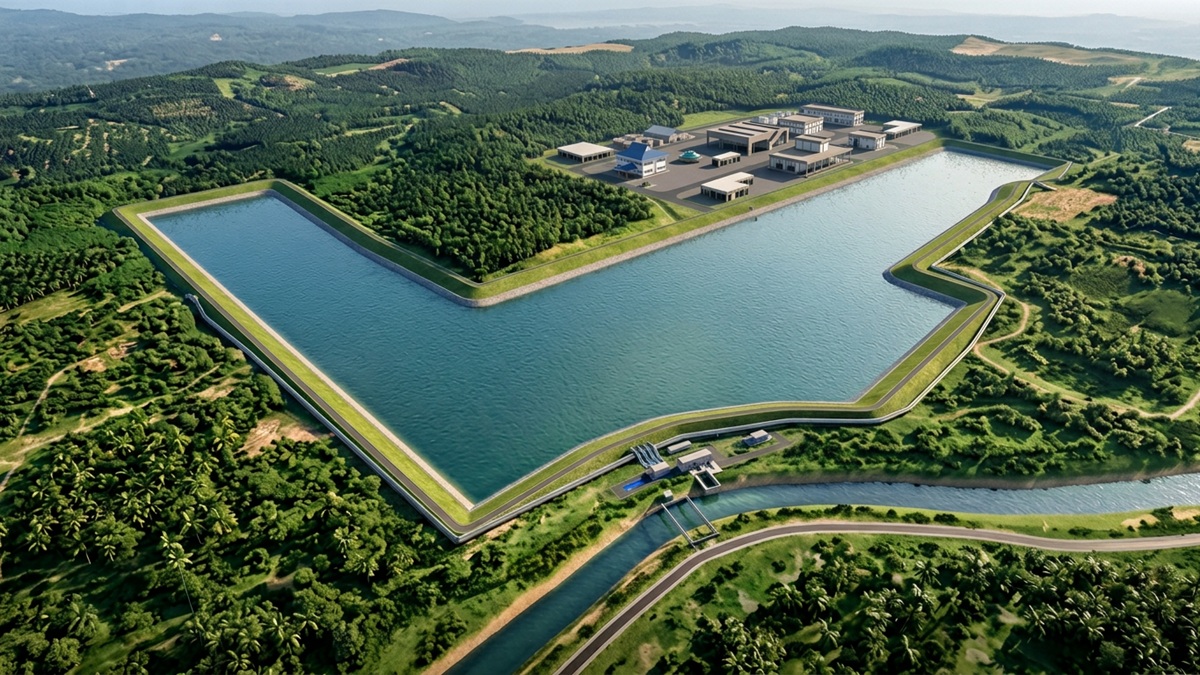
The investment will fund the construction of an off-river storage reservoir and a water treatment plant, with a combined objective of strengthening water availability for local communities and supporting the operational requirements of Google’s upcoming data centre campus at Springhill Industrial Park.
Developed in coordination with the Negeri Sembilan State Government and Syarikat Air Negeri Sembilan Sdn Bhd (SAINS), the project will be undertaken by Gamuda Berhad. Upon completion, ownership of the facilities will be transferred to Menteri Besar Negeri Sembilan (Incorporated) (MBINS), the state-owned statutory body responsible for managing government assets.
The proposed water treatment plant will have a production capacity of 65 million litres per day (MLD), providing treated water for domestic and commercial consumption, as well as Google’s planned data centre operations.
Off-river storage to enhance supply resilience
The reservoir will be developed along the Linggi River and designed to capture excess river flows and rainfall, particularly during periods of high water availability. The stored raw water will subsequently be channelled to the treatment plant for purification and distribution.
During periods of lower river flows, the facility will draw on stored reserves to maintain water availability without disrupting the river’s natural flow. The approach is also intended to help mitigate flood risks in surrounding flood-prone areas by capturing excess water during high-yield seasons.
The integrated reservoir and treatment infrastructure is expected to strengthen the state’s water supply resilience while providing additional capacity to accommodate future demand from residential, commercial and industrial users.
Dato’ Haji Najmuddin Sharif bin Sarimon, Chief Executive Officer of Invest Negeri Sembilan, said the development represents an important milestone in attracting high-value digital infrastructure investment while aligning private-sector participation with the state’s long-term development priorities.
He highlighted the importance of coordinating water and power infrastructure improvements alongside investment in digital facilities, noting that such collaboration could create wider economic opportunities for local businesses and the workforce.
Dato’ Ir. Haji Mohd Yazid bin Ahmad, Chief Executive Officer of SAINS, said the additional 65 MLD of potable water capacity would strengthen the state’s public supply system and support the needs of both residential and commercial consumers.
He added that the development demonstrates the role of public-private partnerships in ensuring water infrastructure keeps pace with economic and industrial expansion.
Water stewardship and digital infrastructure
Google’s investment forms part of its broader digital infrastructure development in Negeri Sembilan, which includes the planned data centre campus, shared water infrastructure and workforce development initiatives.
According to Drew Byrnes, Director and Head of Global Infrastructure and Energy, Asia Pacific, at Google, the funding reflects the company’s global ambition to replenish 120% of the freshwater volume it consumes.
He noted that Google’s local water risk assessment did not identify its water sources as being at high risk of scarcity or depletion, but the company is proceeding with the investment as part of its approach to sustainable infrastructure development.
The company also stated that it would cover 100% of the electricity consumed by its data centre campus, together with the direct infrastructure costs required to connect the facility to the national grid, in compliance with applicable local regulations.
The planned campus will be designed to operate with high energy efficiency and support Google’s digital services, including Search, Maps and Chrome, used by individuals and businesses across Malaysia.
Clean energy development and workforce training
Alongside its water infrastructure investment, Google is expanding its collaboration with SOLS Foundation to support education and workforce development in Malaysia’s clean energy sector.
Two initiatives will be introduced in Negeri Sembilan from early 2027, targeting school students and young people seeking technical employment opportunities.
The first, Solar Explorers and Solar Futures, will establish a Solar and Energy Lab at each participating public school. Each installation will feature a 2.56-kilowatt-peak (kWp) solar array and 5.4 kilowatt-hours (kWh) of battery storage.
Teachers will receive training to incorporate the facilities into classroom and co-curricular activities. Primary school students will be introduced to solar technology and energy-saving practices, while secondary students will gain exposure to clean energy careers and relevant training pathways. The installations will also provide renewable electricity and backup power for participating schools.
The second initiative, Digital Skills for the Renewable Energy Workforce, will introduce a specialised 36-hour training programme as a permanent component of the SOLS Solar Academy. The programme targets young people from lower-income backgrounds and Indigenous communities, equipping them with digital competencies relevant to technical roles in the renewable energy industry.
Training will cover digital applications used in solar system sizing, load calculations, inverter and grid performance monitoring, and field reporting. These skills will complement existing vocational training in solar photovoltaic installation, electric vehicle charging infrastructure maintenance and energy system operations.
Google is also supporting the addition of new renewable energy capacity to Malaysia’s national grid through Power Purchase Agreements (PPAs) with energy developers, including consortiums led by Shizen Energy-Solarvest and TotalEnergies.
The agreements are intended to facilitate financing for new clean energy generation facilities, including utility-scale solar farms, while supporting the expansion of local employment and technical capabilities.
Solarvest’s existing 29.99MWac Corporate Green Power Programme solar farm in Gurun, Kedah, developed in partnership with Shizen Energy and HSS Engineering, is among the projects contributing renewable electricity to Malaysia’s grid under Google’s clean energy strategy.
Through its investment in shared water infrastructure, Google is linking digital infrastructure expansion with additional water treatment capacity, storage development and renewable energy initiatives. The project will add new potable water production capacity to Negeri Sembilan’s supply system while supporting the state’s longer-term infrastructure and economic development requirements.