Asia’s Water Paradox: From Water Abundance to Water Security by 2035
By Nooraishah Omar, Asian Water Magazine
Asia’s water paradox is not simply that the region has too little water. It is that abundant water is increasingly difficult to convert into reliable, accessible and usable water.
Asia is home to some of the world’s great rivers, receives vast quantities of seasonal monsoon rainfall and contains the glaciers and snowfields of the Hindu Kush Himalaya. Yet the region also experiences severe droughts, catastrophic floods, declining groundwater, polluted waterways and unequal access to safe water.
The problem, therefore, is not simply that Asia is running out of water. It is that water is increasingly available in the wrong place, at the wrong time, in the wrong form—or in a condition that makes it difficult to use.
This distinction will become increasingly important by 2035. Climate change, urbanisation and economic growth are not necessarily removing water from the Asian continent. They are making the relationship between water availability and water security more complicated.
Asia’s defining water challenge over the next decade will be to convert water abundance into water reliability.
A Continent of Water
At first glance, Asia appears exceptionally well endowed with water. The continent contains the Yangtze, Ganges, Brahmaputra, Mekong, Indus, Irrawaddy and many other major river systems. The Asian monsoon delivers enormous volumes of rainfall. The mountains of the Hindu Kush Himalaya store water as snow and ice and release it gradually into downstream river systems. Yet these sources are not evenly distributed. Some parts of Asia are among the world’s wettest regions, while others are arid or semi-arid. Even within the same country, water availability can vary dramatically between regions and seasons.
More importantly, the annual amount of water does not tell us whether that water will be available when people need it. A farmer needs water during a particular growing season. A city needs a reliable supply throughout the year. An ecosystem needs sufficient environmental flows. A hydropower system depends on predictable river conditions. A year with abundant rainfall can therefore still contain periods of serious water stress.
This is the first part of the paradox: Asia can have plenty of water without having enough reliable water.
When Too Much Becomes Too Little
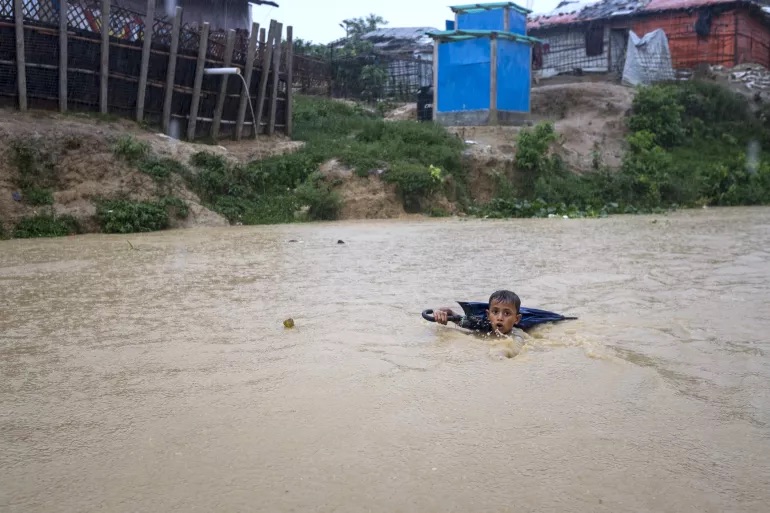
The paradox becomes most visible through Asia’s floods and droughts. During the monsoon season, intense rainfall can overwhelm rivers and drainage systems, displace communities and damage infrastructure. In other periods, the same regions can experience prolonged dry conditions. Asia therefore faces a strange combination: too much water when it cannot be safely absorbed, and too little when it is needed.
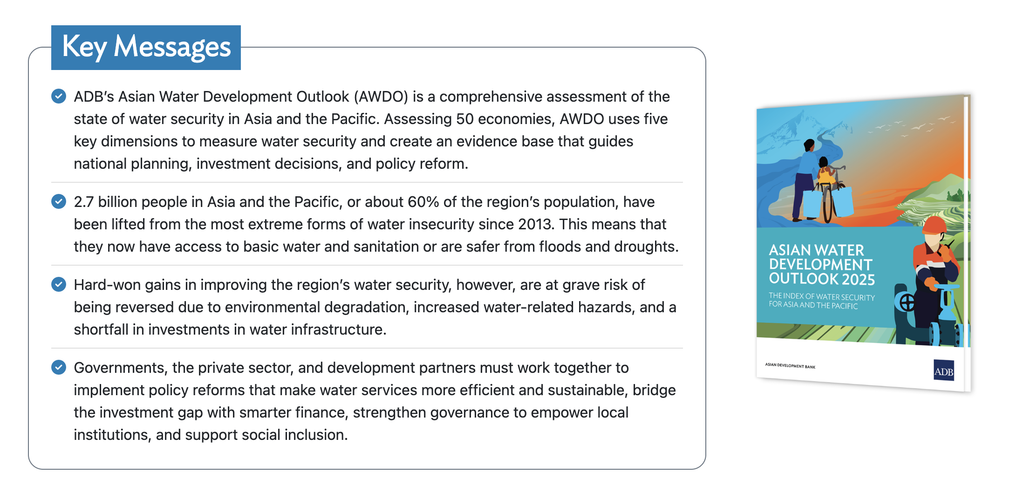
The Asian Development Bank’s Asian Water Development Outlook 2025 highlights the scale of the problem, noting that Asia and the Pacific account for around 41% of global flood events. The challenge is not simply the volume of rainfall. It is the increasing variability in when and where that rainfall arrives.
Climate change makes this more consequential. Rising temperatures affect evaporation and water demand, while changes in rainfall patterns, snow and glacier dynamics can alter the timing of river flows. This means that conventional water planning—based heavily on historical rainfall and river-flow patterns—is becoming less dependable.
By 2035, resilience will depend increasingly on managing variability, not merely calculating average water availability.
The Water That Cannot Be Used
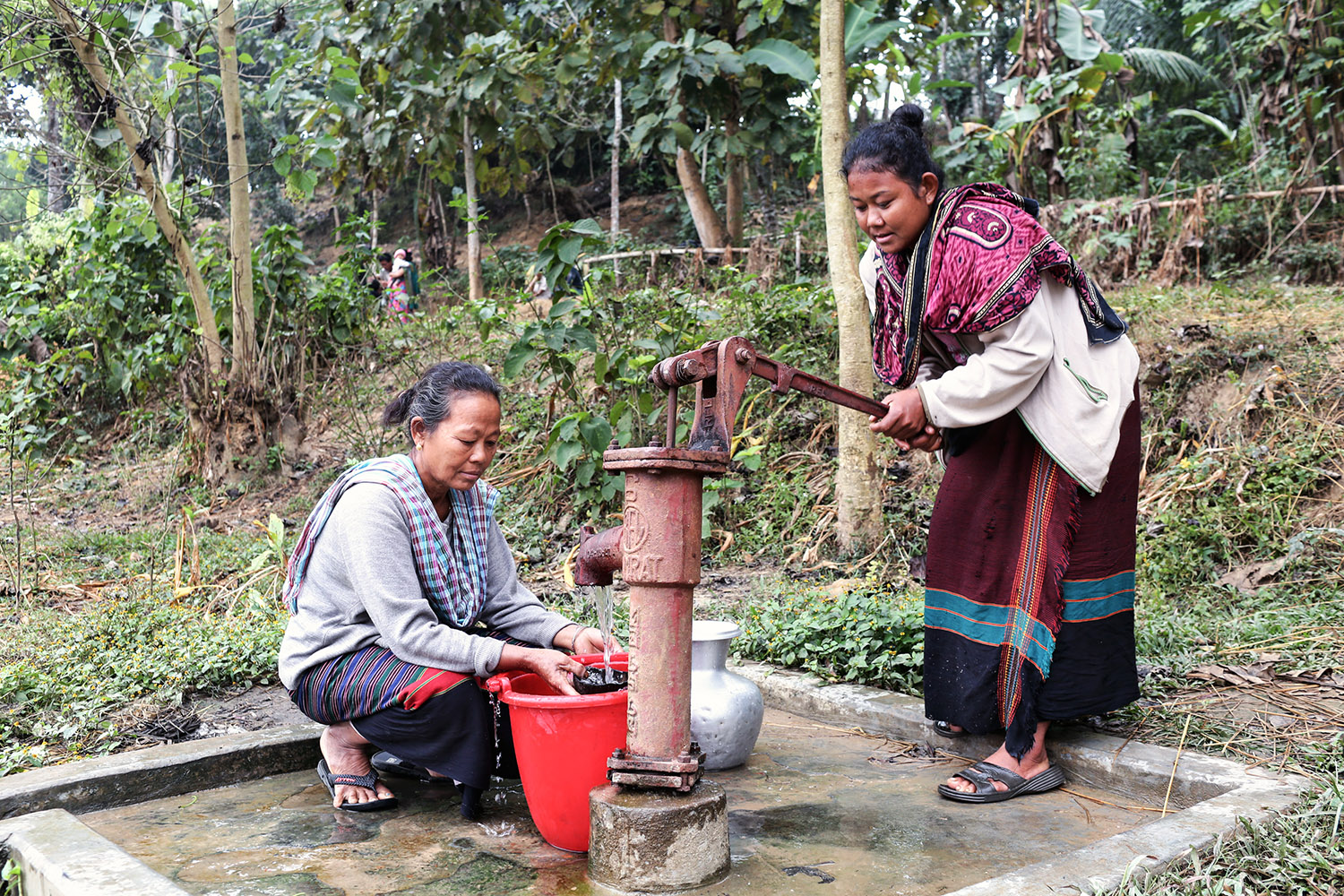
There is another dimension to the paradox: water can exist in abundance but still fail to provide security because it is polluted. A river may carry enormous quantities of water, but if it is contaminated by untreated wastewater, industrial discharge or agricultural runoff, the effective supply of usable freshwater is much smaller. The same principle applies to cities.
The Asian Development Bank estimates that around 80% of wastewater in Asia and the Pacific is untreated. This represents not only an environmental problem but a missed opportunity. Water that could potentially be treated and reused instead becomes a source of pollution.
This creates an important shift in thinking. Water security is not only about finding new sources. It is also about protecting and recovering existing sources. By 2035, the ability to treat and reuse wastewater could become increasingly important, particularly in water-stressed cities. Reducing leakage from distribution networks and improving water efficiency can similarly increase the effective supply without necessarily extracting more water from rivers and aquifers. In this sense, the cheapest new source of water may sometimes be the water that is already being wasted or polluted.
The Ground Beneath the Paradox
Groundwater reveals another reason why water abundance can be misleading. Across Asia, groundwater provides drinking water and supports agriculture and industry. It is particularly valuable during droughts because it can act as a buffer when surface-water supplies decline. But this buffer can be overused.
If farmers and cities pump groundwater faster than aquifers naturally recharge, today’s solution to water scarcity can become tomorrow’s source of insecurity. The danger is difficult to see because groundwater depletion is often invisible until wells begin to fail, pumping costs rise or land subsidence becomes apparent. Climate variability could intensify this pressure. If rainfall becomes less reliable, dependence on groundwater may increase precisely when aquifers are already under stress.
This produces a second-order version of Asia’s central paradox: The more unreliable surface water becomes, the more valuable groundwater becomes—and the more vulnerable groundwater may be susceptible to overuse. Managing this resource will require better monitoring, clearer extraction rules and greater attention to the natural recharge capacity of individual aquifers.
The Himalayas: Storing Water, Losing Certainty
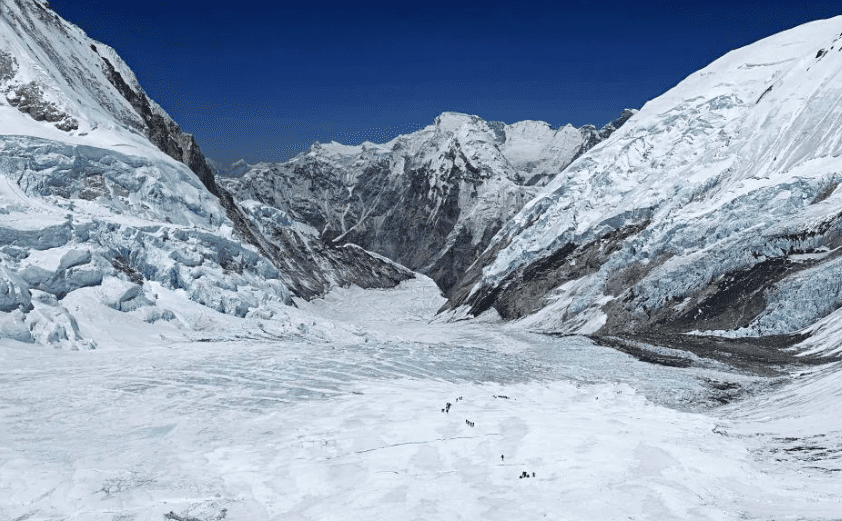
The Hindu Kush Himalaya provides perhaps the clearest illustration of why water security is about timing and reliability rather than simply quantity.
Mountain snow and glaciers act as natural stores of freshwater. Their melt contributes to river systems that support enormous populations downstream. But these natural storage systems are changing as the climate warms.
Changes in snow and glacier conditions can affect both the timing and amount of downstream flows. Increased melt can contribute to short-term risks, while long-term changes raise concerns about the reliability of water supplies.
The paradox here is subtle. Asia possesses an extraordinary natural water-storage system, but the climate processes governing that system are becoming less predictable. That has consequences far beyond the mountains themselves. River basins cross national boundaries, meaning that changes upstream can affect agriculture, energy, ecosystems and communities downstream.
The value of the Himalayan water system therefore lies not only in the quantity of water it contains, but in its ability to regulate water over time. As that regulatory function changes, water security becomes increasingly a question of managing uncertainty.
Cities That Have Water Problems and Flood Problems
Asia’s cities offer perhaps the most visible expression of the same paradox. Rapid urbanisation is increasing demand for water for households, industry, services and food production. At the same time, urban expansion replaces permeable land with roads, buildings and other hard surfaces.
The result can be remarkably contradictory. A city may experience serious flooding during intense rainfall and water shortages during a dry spell. Rainwater arrives faster than drainage systems can handle it, while less water is absorbed into the ground to replenish aquifers. During dry periods, cities may then depend more heavily on distant reservoirs or groundwater.
This suggests that urban water security cannot be achieved simply by bringing more water into cities. Cities must also become better at absorbing, storing, treating and reusing water.
That means restoring wetlands and waterways where possible, improving drainage, capturing rainwater, reducing leakage and expanding wastewater treatment. The objective is to make cities capable of managing both extremes of the paradox: too much water and too little water.
From Abundance to Reliability
The central policy question for Asia is therefore changing. For much of the past, water policy was often framed around increasing supply: build another reservoir, develop another source, extend another pipeline or pump more groundwater.
Those measures remain important in many circumstances. But they do not resolve the underlying paradox if water availability itself is becoming more variable. A more resilient approach would focus on the entire water cycle.
Rainfall needs to be captured where appropriate. Floodplains and wetlands need to be protected. Groundwater needs to be replenished and managed. Wastewater needs to be treated and, where suitable, reused. Agricultural systems need to use water more efficiently. Cities need infrastructure capable of coping with both drought and extreme rainfall.
This is ultimately a shift from water supply management to water system management. It also requires recognising that natural ecosystems are part of the water system. Forests, wetlands, mangroves, rivers and aquifers provide storage, filtration and flood protection. Protecting them can reduce pressure on engineered infrastructure and increase resilience.
The 2035 Test
Asia is unlikely to become a uniformly water-scarce continent by 2035. That would oversimplify a much more complicated reality. The more important risk is that the continent’s enormous water resources become increasingly difficult to depend upon.
Water may arrive in increasingly intense bursts rather than being distributed evenly. Rivers may become more variable. Groundwater may be depleted faster. Pollution may reduce usable supplies. Cities may alternate between flooding and shortage. Mountain water systems may become less predictable.
The paradox will therefore remain: Asia can have abundant water and still be water insecure. The test for 2035 is whether governments can close the gap between those two realities. That means measuring success not simply by how much water exists, but by whether people, farms, industries, cities and ecosystems can depend on sufficient clean water when they need it.
Asia does not necessarily need to discover an entirely new water supply. It needs to become better at turning the water it already receives into water it can reliably use, store, protect and share. That is the transition from water abundance to water security—and it may be the defining water challenge for Asia over the next decade.