
Kurita Completes Disassembly Inspection and Analysis of Water Recycling System Returned to Earth after On‑Orbit Demonstration Aboard the ISS
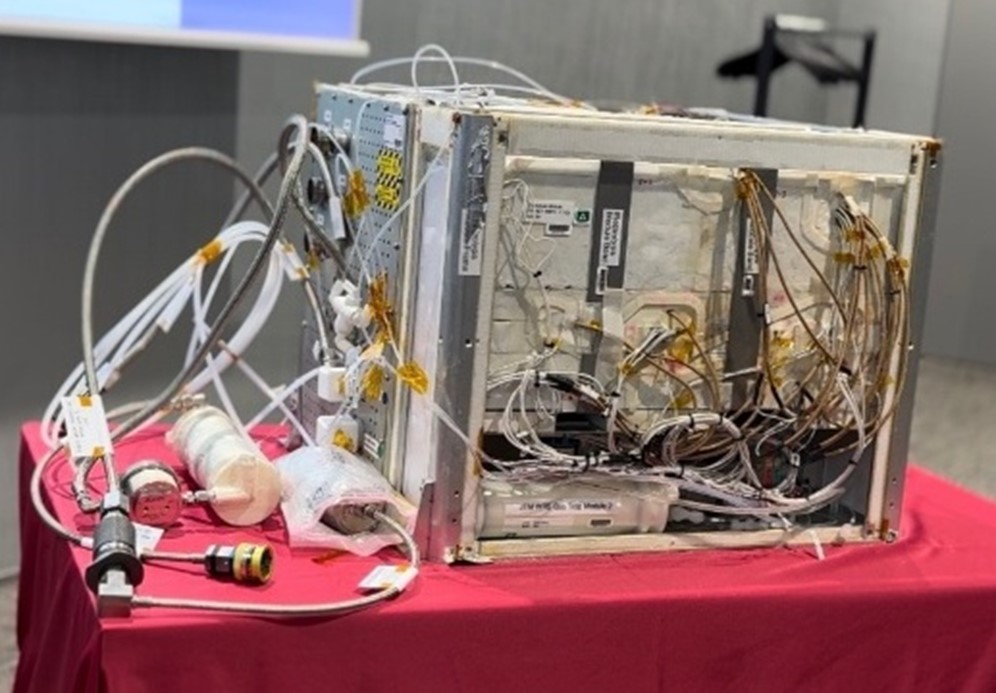
Kurita Water Industries Ltd. has conducted disassembly inspection and analysis of the Water Recycling System which was returned to Earth after completing an on‑orbit demonstration1 aboard the International Space Station (ISS) carried out by the Japan Aerospace Exploration Agency (JAXA). These activities were undertaken to confirm degradation and changes in system characteristics resulting from operation under microgravity conditions. Kurita has completed this series of activities and reported the results to JAXA.
This demonstration project was initiated in 2011 under a joint research agreement between JAXA and Kurita to study next‑generation water recycling systems. Kurita developed the system, which was designed to recycle urine to be generated onboard spacecraft to water suitable for drinking, and delivered it to JAXA in 20192. It was subsequently launched in the same year to the Japanese Experiment Module “Kibo” aboard the ISS, where an on‑orbit demonstration was conducted by JAXA for approximately four years through 2023, with technical support provided by Kurita from the ground3. The system achieved the expected performance and generated valuable insights into water treatment characteristics under microgravity conditions.
In May 2025, the system recovered on Earth following the completion of the demonstration. This was in line with Kurita and JAXA’s intention to utilise changes in the system after operation for future space development. With a total weight exceeding 100kg, it was the first large-scale system of its kind returned to Earth by JAXA. After its recovery, Kurita engineers conducted disassembly inspections and related analyses at Kurita Innovation Hub (Akishima City, Tokyo), the Group’s research and development base.
As a result, several issues requiring further consideration from design and operational perspectives were identified. These issues include the unique behavior of water and air bubbles inside the system under microgravity conditions and the extent of component degradation and surrounding equipment resulting from an extended on-orbit operation exceeding four years, which was longer than initially anticipated. Kurita will use the knowledge obtained from this demonstration to advance technological development related to water recovery and recycling in space.
The Kurita Group will collaborate with the various public, private and academic organisations, aiming to contribute to humanity’s challenge to space by advancing water recovery and purification technologies in space and constructing sustainable space plants. In addition, it will utilise the knowledge gained from research and development in the space field to create and provide solutions that can help resolve social and industrial issues on Earth, thereby contributing to the realisation of a sustainable society.
- On‑orbit refers to the space surrounding Earth at altitudes ranging from approximately 100km to several thousand kilometres. ↩︎
- Refer to a news release on 24 July 2019: Kurita Delivers Water Recycling Technology Demonstration System for the Japanese Experiment Module “Kibo” on the International Space Station —Verification Testing at the Japanese Experiment Module “Kibo” to Start in 2019— ↩︎
- Water in Space | Kurita Water Industries | Kurita Group ↩︎